Physiotherapist jobs in London and private practice
Therapyway Editorial Team · Published 27 July 2026 · Updated 27 July 2026 · 10 min read

If you are looking for physiotherapist jobs in London, start with NHS Jobs and CSP Jobs, then go direct to the private clinic groups, which recruit far more continuously than their advert volume suggests. Between them those three cover most of the real vacancies.
This is not a vacancy list. Therapyway is a marketplace rather than an employer, so we do not advertise posts. What follows is the part the job boards skip: what London physio roles pay in 2026/27, why the private physiotherapy market here is harder to break into than the demand suggests, and the insurer question that decides more about private physio income than anything on your CV.
Where London physiotherapy vacancies are actually posted
NHS Jobs carries acute trusts, community trusts and the rotational Band 5 posts that most physiotherapists still use to build breadth early on.
CSP Jobs is the profession's own board and carries private, sports and education roles alongside NHS posts.
Private clinic groups are the difference between physiotherapy and the other allied health professions. London has a dense layer of established MSK and sports clinics, hospital outpatient physiotherapy departments and multi-site groups, and most of them recruit through their own careers pages and through word of mouth rather than the aggregators. If you want private work, the clinic sites are the primary source and everything else is secondary.
Primary care networks recruit physiotherapists as First Contact Practitioners, seeing musculoskeletal patients directly without a GP appointment first. These are posted variously through NHS Jobs, individual PCN sites and general practice recruitment channels, which makes them easy to miss if you only watch trust vacancies.
Agencies and locum desks cover short notice and rotational cover. Useful for seeing several settings quickly, weaker for continuity.
One caution on the aggregators. A search for physiotherapy roles in London returns results in the hundreds, but the count mixes in assistant and technician posts, sports massage roles, and adverts that mention physiotherapy without being registered practitioner jobs. Filter before you draw conclusions about the market.
What physiotherapist jobs in London pay in 2026/27
For NHS posts under Agenda for Change, from 1 April 2026:
Band | Typical physiotherapy role | Annual salary (2026/27) |
|---|---|---|
5 | Newly qualified or rotational | £32,073 to £39,043 |
6 | Specialist physiotherapist | £39,959 to £48,117 |
7 | Highly specialist, team lead or First Contact Practitioner | £49,387 to £56,515 |
London posts add a High Cost Area Supplement. Inner London is 20% of basic salary in 2026/27, with a minimum of £5,794 and a maximum of £8,746. Outer London and Fringe pay less, and the gap between zones is worth several thousand pounds a year at the same band, so check which one a trust sits in before comparing two offers.
Private clinic employment works differently and the difference catches people out. Rather than a flat salary, many private physiotherapy roles pay a lower base plus a percentage of the fees you generate, or a straight percentage as a self-employed associate. The headline figure in the advert can look strong while depending entirely on how full your diary gets and who fills it. Ask what the split is, ask who owns the patient relationship, and ask what happens to your income in a quiet January.
The London private physiotherapy market is crowded, and pretending otherwise helps nobody
Physiotherapy sits in a different position from speech and language therapy or occupational therapy, and the honest version is worth stating plainly.
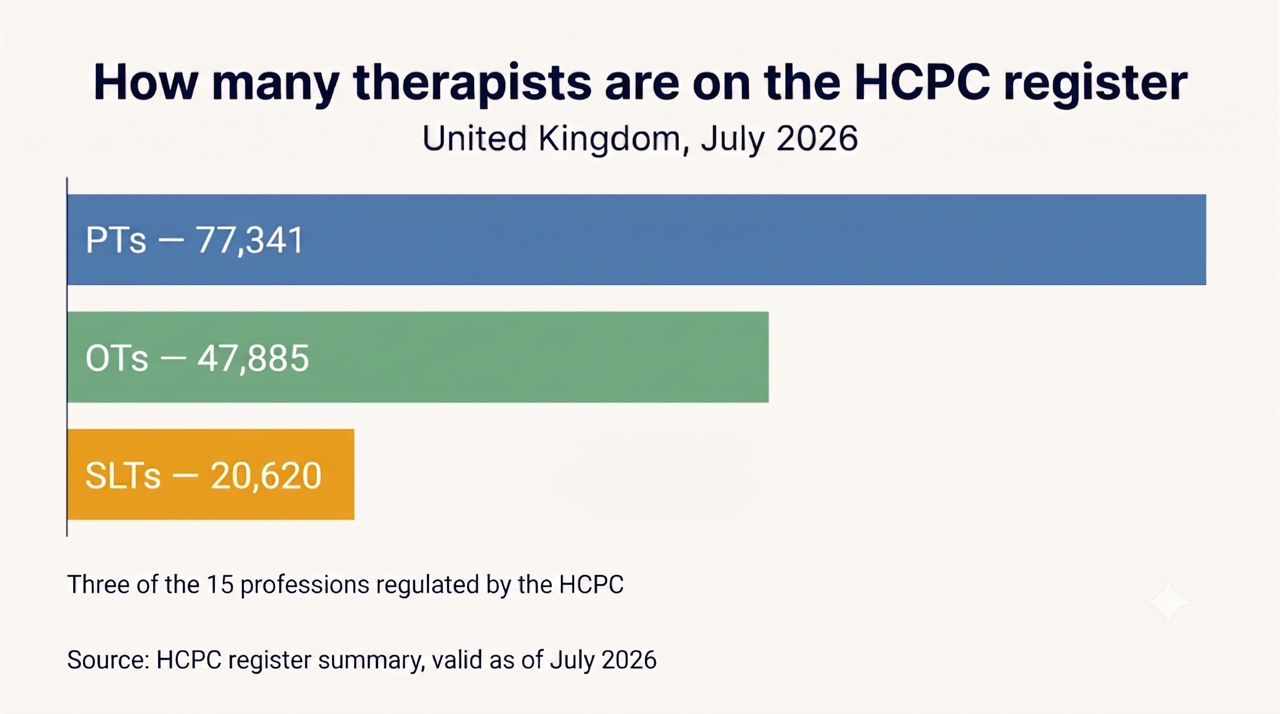
As of July 2026 the HCPC register holds 77,341 physiotherapists. For scale, the same register lists 47,885 occupational therapists and 20,620 speech and language therapists. Physiotherapy is not a small profession competing for scraps of attention. It is the largest of the three by a wide margin.
The trajectory behind that number matters too. Nuffield Trust analysis cited by the CSP in February 2024 found the number of registered physiotherapists in England grew by more than 93% between June 2012 and June 2023, and the CSP reports that physiotherapy courses continue to attract many more applications than there are places.
Supply has grown quickly. NHS establishment has not grown at the same pace, which is a large part of why so many physiotherapists have moved into private work, and why central London in particular has a dense private physiotherapy market with established clinics, hospital outpatient departments and sports medicine practices all competing for the same self-pay and insured patients.
That is not a reason to avoid private practice. It is a reason to be specific. A generalist MSK physiotherapist opening in zone one is entering a market with incumbents who have years of referral relationships. A physiotherapist with a defined specialism, whether that is vestibular rehabilitation, women's health, persistent pain, post-surgical rehab for a particular procedure, or a sport with a real local community around it, is answering a narrower question that fewer people can answer.
The demand is genuinely there. The competition for it is genuine too, and any advice that mentions only the first half is selling you something.
The insurer question, which decides more than most people expect
A large share of private physiotherapy in London is paid for by health insurance rather than by patients directly. Whether you can access that work is a structural question, not a clinical one, and the criteria are public.
Bupa is the clearest example, and its recognition criteria are worth reading closely because they surprise people:
Bupa recognises the practice as a whole, not individual physiotherapists.
Each practice needs a named lead clinician registered with both the CSP and the HCPC, with at least five years' post qualification experience in full time practice.
Every physiotherapist at the practice must be registered with the CSP, registered with the HCPC, and hold current indemnity insurance up to the amount advised by their professional or regulatory body.
Every physiotherapist treating Bupa customers needs an enhanced DBS certificate with the appropriate child or adult barring list check, or the AccessNI or Disclosure Scotland equivalent.
The practice invoices Bupa directly online and is paid by BACS, and does not invoice the customer.
Two things follow from that list.
First, CSP membership is doing real commercial work here. Legally you need HCPC registration and nothing else. Bupa requires CSP registration as well, so what is optional in law is effectively mandatory if you want insured patients. Budget for it.
Second, the five year requirement sits with the lead clinician rather than every physiotherapist, and recognition attaches to the practice. For a newly independent physiotherapist that shapes the decision considerably. Joining an already recognised practice as an associate gives you access to insured patients immediately. Setting up alone, without five years post qualification, does not, and no amount of marketing changes that.
Other insurers set their own criteria and they are not identical, so check each one you want to work with rather than assuming Bupa's rules generalise.
What you need in place before you take private clients
HCPC registration. "Physiotherapist" and "physical therapist" are both protected titles. Under Article 39(1) of the Health Professions Order 2001, using a protected title with intent to deceive when you are not on the register is a criminal offence, and the HCPC notes that prosecution can lead to a substantial fine and a criminal record. The offence is about holding yourself out as registered when you are not. A lapsed renewal is a registration matter to resolve with the HCPC rather than the same thing, though you should stop practising and stop using the title until it is sorted. The offence covers implication as well as direct use, so check how your profile and any advertising describe you.
Professional indemnity insurance. A condition of HCPC registration. If you are seeking insurer recognition, check the level of cover each insurer expects rather than assuming your existing policy satisfies them. If you incorporate, check whether your cover follows you into the company or whether the entity needs its own policy.
CSP membership. Not a legal requirement, but a practical one if you want insured work, and it carries the professional and indemnity infrastructure most private physiotherapists rely on.
An enhanced DBS check with the relevant barred list, or AccessNI or Disclosure Scotland depending on where you work. Required by insurers as well as by most employers.
HMRC registration. Self assessment, VAT threshold monitoring, National Insurance. Sort it before the first invoice, not after.
Supervision and CPD. CPD is a condition of HCPC registration. Independent practice removes the peer challenge that comes free in a department, and for a hands-on profession that matters more than it sounds. Arrange it deliberately.
Where Therapyway fits
Therapyway is a marketplace connecting people looking for therapy with independent, HCPC-registered therapists across the UK. We are not an employer, we hold no vacancies, and registering is not a job application.
To be direct about the boundary: Therapyway serves self-pay clients. It is not an insurer network and it does not give you access to Bupa, AXA or Aviva funded patients. If insured work is your goal, the route is insurer recognition, through a practice, on their criteria.
What it does handle is the self-pay side, where the constraint is being found by someone searching for what you do. You publish a profile with your qualifications, specialisms, availability, location and rates. Clients send appointment requests. Scheduling, records, messaging and payments run in the same place. Given how crowded London physiotherapy is, a clearly defined specialism on your profile will do more for you here than a general one.
The commercial terms in full: joining is free with no card required, and we take 10% of paid bookings only. On an £80 session you keep £72. HCPC verification is the only gate on registration.
What we cannot tell you is how much work will come. We do not guarantee referrals, bookings or income, and any platform that promises otherwise deserves scepticism. Read the current registration terms before you sign up, and treat it as one channel rather than a replacement for the referral relationships that private physiotherapy still runs on.
Frequently asked questions
Does Therapyway have physiotherapist vacancies in London?
No. Therapyway is a marketplace rather than an employer and does not advertise posts. For salaried London vacancies, use NHS Jobs, CSP Jobs and the private clinic groups' own careers pages. Therapyway is relevant if you want self-pay private clients alongside or instead of a post.
Do I need to be a CSP member to work as a physiotherapist in the UK?
Not legally. HCPC registration is the legal requirement. CSP membership becomes effectively necessary if you want insurer recognised work, because insurers including Bupa require it alongside HCPC registration.
How do I get on a private health insurer's physiotherapy network?
Criteria vary by insurer. Bupa recognises the practice rather than the individual, and requires a named lead clinician registered with both the CSP and the HCPC who has at least five years' post qualification experience in full time practice, with all physiotherapists at the practice CSP and HCPC registered, insured, and holding an enhanced DBS check. Check each insurer separately.
Can I do private work while employed by the NHS?
Many physiotherapists do. Check your contract for secondary employment and conflict of interest clauses first, tell your employer if the contract requires it, and never take private referrals from your own NHS caseload.
How much does private physiotherapy cost in London?
Private sessions in the UK commonly run from £60 to £120 for around 50 minutes, with London towards the upper end and specialist clinics sometimes above it. You set your own rates on Therapyway. Treat that as what the client pays rather than your take-home: platform or clinic commission, room hire, insurance, equipment and CPD all come out of it before any comparison with an hourly NHS rate.
Is "physiotherapist" a protected title?
Yes, and so is "physical therapist". Using either with intent to deceive when you are not HCPC-registered is a criminal offence.
I qualified outside the UK. What do I need?
HCPC registration through the international application route before you practise or use the protected title here. That has to be complete before you register with Therapyway.
Ready to take private clients?
If you are HCPC-registered and want to build a self-pay caseload on your own terms, you can see how Therapyway works for therapists and register in a few minutes. Free to join, 10% on paid bookings, no vacancy application involved.